
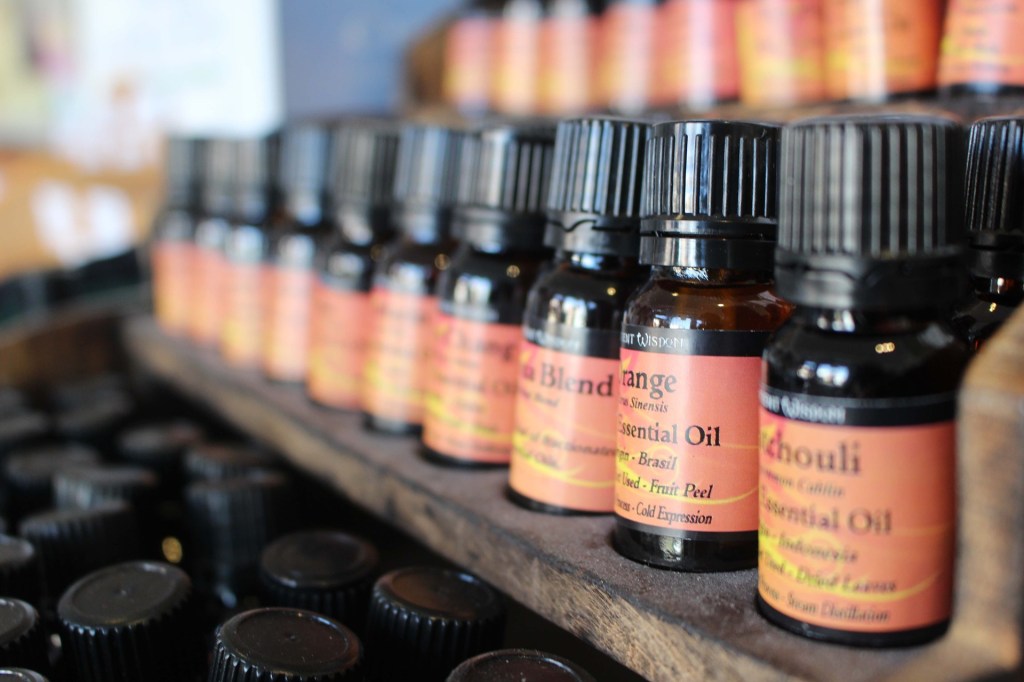
An acquired taste, Pogestemon cablin, otherwise known as patchouli is a herb that’s native to Asia although often distilled in Europe from the dried leaves. Fabrics and clothes transported to the west from the east were layered with the leaves because it is an impressive insecticide. As western manufacturers tried to emulated the same fabrics they discovered they couldn’t sell them without the patchouli aroma.
I find patchouli to be quite a sweet heady aroma, musky and deep, similar to vetiver, that lingers on fabric sometimes even after a wash. It’s one of the very few oils, if not the only one, that matures well with age, both in and out of the bottle. In fact, the older the oil the better I prefer it, it seems to mellow. It’s used a lot in the perfumery industry as a fixative and to mask more unpleasant aromas, which to some who find patchouli disagreeable is something of an oxymoron. It also dampens the sweetness of some oils like rose and lavender, and lengthens their note. Known particularly as the oil of choice for 60’s hippies, possibly because of this masking effect – it hid the smell of marijuana.
It’s a dark orange viscous liquid that has been used throughout history as an antidote to poisonous insect and snake bites. Known as a prophylactic it’s much used as a preventative as it helps those with a weak immunity. Because of it’s phlebotonic properties it can help in the case of varicose veins and for the vascular system in general. It can help reduce fluid retention and reduce the appetite which is useful if you want to lose weight and treat cellulite. It’s greatest action though is in it’s anti-depressive nature, which could undoubtedly help with the weight loss – helping those struggling with how they feel about themselves. It’s a very grounding oil, bringing clarity to the mind and helping to bring thoughts together. Excellent for the over-thinker it works well for the ‘remote individual’, those that live in their heads and brings them back in touch with their bodies. It’s a stabilising oil for those who have chronic anxiety from over work and encourages creativity, spontaneity and enjoyment. For some it’s known as an aphrodisiac and can bring out one’s sensuality.
For me patchouli’s greatest benefit is for it’s cell regenerative properties. Because one of it’s main active principles contains patchoulene, which is very similar to azulene in chamomile, it is anti-inflammatory giving it a calming and yet gently stimulating action. For this reason it’s used a lot in skin care preparations to help eczema and dry skin, scar tissue and the more mature or damaged skin. I team it with geranium and mandarin in my Hibiscus Face Balm to help regenerate over night. (Contact me direct for details) It also works on acne and impetigo too, due to it’s astringent, antiviral and antibacterial action.
Of course, all this only works if you like the smell…
 Vital Force Naturals
Leave a comment