
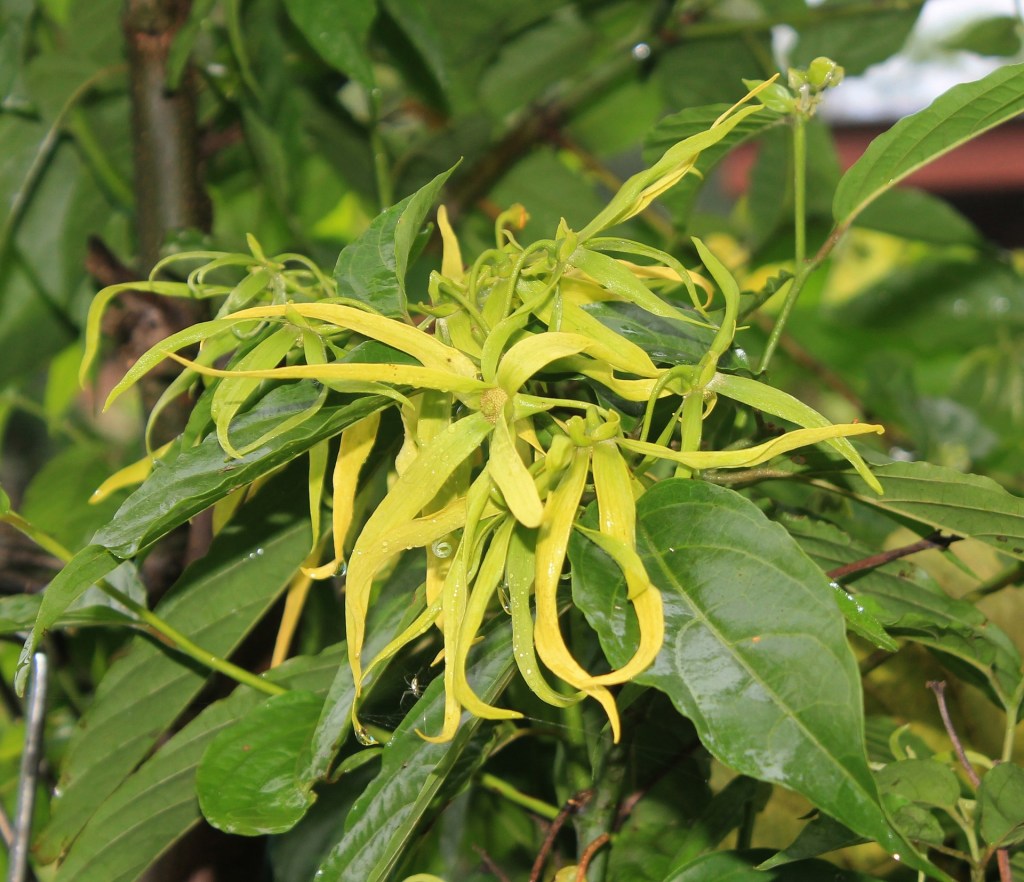
Cananga odorata, Ylang Ylang (pronounced ‘e-lang e-lang’) simply means ‘Flower of Flowers’ in Malayan and in the Philippines ‘alang-ilang’ implies flowers that hang and flutter in the breeze. The islanders would make a pomade from the flowers and coconut oil called ‘boori-boori’ and apply it to the skin to nourish, rejuvenate and prevent infection and fevers. The petals were spread on the beds of newly weds to promote fertility and a happy life together.
The scent is sweet and heady, too heady for some as it can bring on feelings of nausea and headache if used too much or in too strong a dilution. I find it’s best mixed with a citrus oil (my favourite being grapefruit) as it dampens the sweetness and balances out the heavy aroma. It lingers, which is quite lovely in a body butter, as you get the aroma all day, gradually diminishing and softening as the day goes on. It’s very flowery which is not to everyone’s liking, myself included, but with ylang ylang, for me, the aroma is not as clawing as some, a poor mans rose, jasmine or neroli, that mixes well with lighter oils (hence the citrus) and even some of the woody oils, sandalwood and rosewood help to ground the aroma.
Of course when mixing in aromatherapy it’s not just about the smell, it’s also about the therapeutic quality of the oil and what you’re wanting to achieve. Ylang ylang is arguably best known to treat nervous conditions – insomnia, stress and depression. Indeed I’ve used it as a mood lifter as it’s something of a euphoric oil which has been shown to calm anger, agitation and restlessness and aid sleep, something that anyone who suffers from these conditions will know can be hard to manage. Often used to treat heart conditions it slows rapid breathing and heartbeat, but I wouldn’t recommend it as a meditation aid, your omm will soon turn into zzz…. It’s also known as an aphrodisiac, possibly because of it’s calming effect on the nervous system, it helps the body to relax and be at ease with ones-self.
Of course I use ylang ylang in my products for it’s rejuvenating and nourishing effect on the skin. It has a balancing effect, so is excellent for oily and dry conditions. It has a high natural alcohol content, linalool, which is anti-inflammatory and makes it great for treating stretch marks and scars, and can help with joint conditions like arthritis and rheumatism. In the 19th Century it was used in the very popular scalp tonic Macassar oil for hair loss. In fact it was so widely used that Victorian housewives protected the backs of chairs from oily stains with pieces of cloth – ‘antimacassars’! So that’s where that name comes from!
The oil of ylang ylang is distilled over 24 hours, the first fraction being the ‘purest’ and therefore most sought after by the perfumier and most expensive. This is known as ylang ylang extra, the second fraction being slightly inferior and known as ylang ylang superior. And so it goes on until about 10 fractions have been taken which then get combined to form the ‘common’ ylang ylang found in most stores. Most definitely a base note, it’s deep, resonating and penetrating and helps the overall aroma of a blend to linger 🙂


Leave a comment